
1. Summary: The Meta-Game Concept
Elthos solves the ‘blank page’ problem of campaign design by gamifying the transition from cosmogony to geography. Rather than relying on arbitrary GM fiat to determine why a mountain exists or where a prophecy originated, the Elthos Meta-Game functions as a specialized ‘Collaborative Backstory Creation’ system. Players adopt the roles of Young Elkron—divine newcomers born of the void—who must shape a nascent universe.
The system is a dual-layered engine: mechanically, it is a high-stakes strategy game where players vie for ‘Ultimate Supremacy’ as the Elkron Supreme; narratively, it is a historical generator. By the time the meta-game concludes, participants have architected a logically consistent world with mechanical origins for every ruin, race, and divine legacy, creating a Shared World ready for standard RPG play across multiple tables.
2. The Chronological Architecture: The Epochs of Elthos
Progression in Elthos is defined by five distinct eras, ensuring the world’s history is not merely flavor text but a recorded series of mechanical events.
The Epochs of Elthos
| Age Name | Primary Objective | Key Mechanical Focus |
| Primordial Age | Physical World-Shaping | Creation of terrain, features, and GM-instigated Bad Terrains. |
| Dawn Age | Biological & Cultural Genesis | Founding of races, initial cultures, and settlement placement. |
| Heroic Age | Interaction with Mortals | Deployment and resolution of Seeds of Destiny via mortal quests. |
| Twilight Age | Divine Decline & Gambits | Settlement Fate rolls (Decline/Survival); managing divine betrayals. |
| End of Ages | Ultimate Supremacy | A climactic, fixed 6-round God War to crown the Elkron Supreme. |
The transition from macro-creation (mountains/seas) in the Primordial and Dawn Ages leads to the Heroic Age, where gods influence the world through Seeds. The Twilight Age introduces entropy, requiring players to roll for the survival of their civilizations. The timeline concludes with the End of Ages, a highly structured combat sequence where remaining Kismet determines the final pantheon’s hierarchy.
3. Kismet: The Divine Economy of Creation
Kismet is the Mystic Energy driving all divine manifestation. To maintain game momentum, the system recommends a starting pool of 600 Kismet for Young Elkron, though this is a flexible, arbitrary value for GMs to scale based on desired game length. To the mortal perspective, the scale is staggering: 1 Kismet is equivalent to 100,000 Mystic Points.
All expenditures are tracked via the Kismet Ledger, which categorizes the flow of energy across several critical types:
- Creation & Seed Creation: Costs for forming geography or planting destiny.
- Worship Income & Seed Payout: Recurring revenue or rewards for successful mortal quests.
- Gambling & Alliance Costs: Strategic risks and the diplomatic tax of cooperation.
- Gifts & Betrayal Penalties: The cost of divine generosity or the price of breaking faith.
- Throne Desecration: Massive penalties if an Elkron’s sacred seat is violated.
- Boons, Banes, and Twilight Events: Mechanical rewards or catastrophes that alter the world state.
Kismet is not just a score; it is a tactical resource for Manifestation (projecting essence), Possession (wrestling control of mortal wills at 4 Kismet per attempt), and Altering Fortune (spending 1 Kismet per point to tip the scales of any die roll).
4. Narrative Integration: Seeds of Destiny and Forged Fates
The Seeds of Destiny mechanic is the bridge between the high-level meta-game and standard RPG play. Gods plant these seeds, which manifest as specific tasks for mortal heroes.
Each Seed is defined by a comprehensive Seed Block containing:
- Seed Name/Type: Latent, Forged Fate, or Special.
- Total Kismet Invested: The upfront energy cost determining potential power.
- Alignment: Defined on the Law/Chaos and Good/Evil axes.
- Tasks, Taboos, and Deadlines: Specific conditions the mortal party must satisfy to trigger a payout.
- Potential Payout: The Kismet return for the Elkron upon resolution.
Heroic Age Quest & Seed Resolution Log The GM-Referee evaluates mortal quests to determine if they are Seed-worthy. Rewards are governed by alignment parity. A Match Level 2 (where mortal actions align with both the Law/Chaos and Good/Evil axes of the god) yields the maximum payout, while a Match Level 0 can result in a divine Bane or a significantly reduced Kismet return.
5. The GM-Referee: From Neutral Arbiter to Invisible Architect
The GM-Referee is instructed to be maliciously impartial. While providing the illusion of a neutral rules arbiter, the Referee actively injects drama to prevent divine complacency.
- The Three-Phase Reveal Strategy: The Referee introduces the Elder Elkron (Old Ones) through specific mechanical triggers. Phase 1 (Primordial Doubt) is triggered when any Elkron spends 33% of their starting Kismet. Phase 2 (Undeniable Evidence) occurs at a 60% collective Kismet threshold or immediately after the first Alliance is formed.
- Bad Terrains: Any hexes left unclaimed at the end of the Primordial Age are filled by the Referee to frustrate player designs. These include Vales of Poison Gasses, Kaiju Mountains, and Smoldering Lava Lands.
- Local Divinities: These 1-Kismet administrators are created instantly alongside new terrain. They adopt the name of the feature (e.g., the divinity of the mountain Zoklor is named Zoklor). They act as the Referee’s primary interface, offering useful or adverse advice with a mischievous edge. Crucially, if an Elkron destroys a Local Divinity in a fit of pique, that hex is permanently bereft of an administrator, leaving future mortal races without divine guidance.
6. Cosmology and Symbology: Jungian Archetypes and Tarot
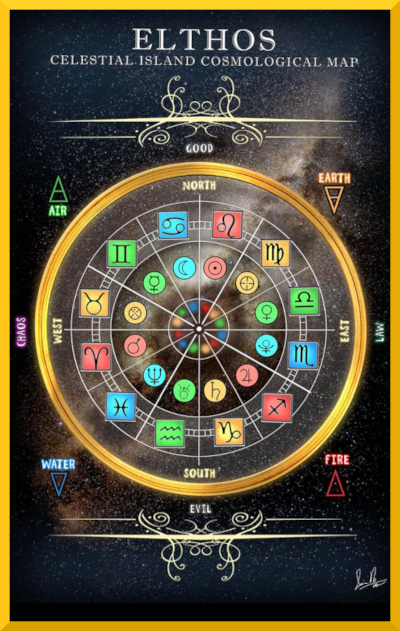
The meta-game occurs on the Celestial Island, a 3600-mile diameter physical embodiment of the cosmic order. The spatial logic follows an As Above, So Below philosophy:
- The Center (Realm of the Id): Represents the inner world of consciousness and contains the Jungian Archetypes (Olympians/Titans).
- The Rim (Realm of Divine Idea): Moving outward leads to the Celestial Zodiac (Planetary/Constellation).
- The Side View: The island is framed by the Dragon Teeth Mountains at the center and the Dragon Spine Mountains at the outer edge, reflecting the verticality of the universe from the Id to Divine Idea.
The Elthos Tarot Deck provides a dual classification for every deity (e.g., Leo as both a Titanic Constellation and the Archetype of Strength). Furthermore, alignment dictates the political landscape and the fundamental Goals of the regional rulers:
| Alignment | Government Type | Ruler’s Goal |
| [G-L] | Monarchy | Wisdom |
| [L-G] | Imperialism | Order |
| [L] | Timocracy | Honor |
| [C-G] | Democracy | Freedom |
| [C] | Barbarians | Independence |
| [L-E] | Oligarchy | Wealth |
| [E-C] | Fascism | Obedience |
| [E] | Tyranny | Lust |
7. Strategic Conclusion: The Value of the Meta-Game Approach
Elthos provides a rigorous framework for setting design that replaces GM whim with competitive logic and malicious seasoning.
- Logical Motivation: Every geographic feature and race exists because a divine player spent Kismet to secure a tactical advantage, ensuring the world feels earned.
- Living History: Ancient ruins encountered in standard campaigns are not mere flavor; they are the mechanical remains of the three-phase reveal or the remnants of previous ages’ conflicts.
- Scalability: The system generates a Shared World usable by multiple GMs, where the mythological ledger remains consistent across diverse campaigns.
Ultimately, Elthos succeeds in generating a history filled with unexpected consequences and epic twists of fate, providing GMs with the malicious delight of watching their players navigate a world that was truly built by the hands of gods.