
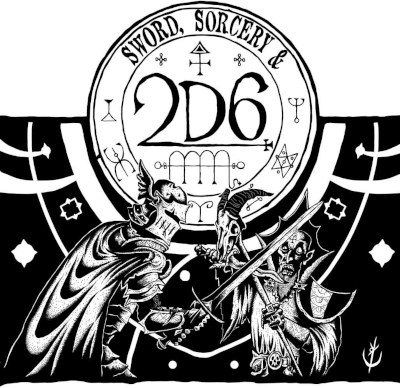
If you are looking for a tabletop experience that strips away the bloat of most modern d20 systems while retaining the high-stakes grit of old-school crawls, Sword, Sorcery & 2D6, hereinafter ‘SS&2d6’ is a title you need to watch. Created by Incerto, this minimalist RPG is designed for 1 to 5 players and emphasizes a DIY (do it yourself) philosophy, encouraging GMs to adapt the rules and create their own content on the fly.
My friends and I have been running a Sunday game for the last three weeks, and it has been a lot of fun. At least for me as the gamemaster (GM). SS&2d6 makes game preparation a breeze. All I need is a basic idea, and then let the Player Characters create the story as they go… even if they don’t necessarily realize they are doing that. There are all these tables in the back of the little rules pamphlet that helps with creating the adventure on the fly, or at least helps to spark the imagination when inspiration is running dry.
You can find the latest version of Sword, Sorcery & 2D6 which is free to download here: https://incerto.itch.io/sword-sorcery-2d6
The Core Engine: PbtA Meets OSR
The game draws inspiration from two major RPG movements: Powered by the Apocalypse (PbtA) and Old School Essentials (OSR). The core mechanic is a simple 2d6 + attribute check.
The results follow the classic PbtA “success at a cost” model:
- 10+ is a complete success.
- 7–9 is a partial success, meaning you get what you want, but at a cost or complication.
- 6 or less is a failure, which interestingly awards the player 1 XP, ensuring that even when things go wrong, your character is learning and progressing.
Lethality and Resilience
In this system, adventurers are competent but far from immortal. All characters start with exactly 6 HP, and power scaling is intentionally kept low. This creates a healthy mix of lethality – deadlier than modern rule sets but more forgiving than the most brutal old-school games.
A standout feature is the Armor and Defense system. Damage is first subtracted from the defense provided by your gear. However, armor deteriorates; once its defense reaches zero, the equipment breaks and must be repaired, leaving the character vulnerable to direct HP damage. If you hit 0 HP, you enter a Death Saving Check where the presence of previous Injuries makes survival significantly harder.
Dangerous, Free-form Magic
The magic system is arguably the game’s most evocative feature. There are no specific spell lists or slots; instead, sorcery is open-ended, allowing players to use their creativity to define what their magic does.
However, this power comes with a price: Corruption; perhaps the most interesting aspect of this game. Sorcerers and Healers must track a lifetime threshold of 10 corruption points. Using magic risks gaining corruption, which can lead to physical or psychic alterations. If a character exceeds their threshold, they are permanently lost, potentially becoming a villain or an NPC. This makes every spell a tense calculation of risk versus reward.
Character Depth Through Weakness
Character creation is lightning-fast, involving the allocation of five modifiers: [+2, +1, 0, 0, -1]. Beyond stats, players define their character through Specialties (skills that grant advantage) and Weaknesses. The game creates incentives for roleplaying by awarding XP when players invoke their own Weaknesses, Injuries, or negative Conditions during a session.
A Toolkit for the Creative GM
For the Gamemaster, the rulebook serves as a robust toolkit. Since the game is player-faced (meaning the GM rarely rolls dice), the focus stays on the narrative and reaction to player choices. The book is packed with random tables for everything from quest hooks and dungeon rooms to creature activities and ‘Sorcery Mishaps’.
Final Verdict
This game seems to be in a permanent Beta Test, so expect regular updates. There are a few issues that I find annoying, but I suspect they will get ironed out with time:
- The author does not provide a new version number or date for the latest update which means its hard to know if everyone is using the exact same set of rules – I do hope the author starts doing something to fix this even if it is just putting a date on the title page to when that version was posted.
- I believe the author’s first language is Portuguese, and I think he writes the rules in that language and then translates to English. This works fine, but sometimes there are a few Portuguese words that slip through. Also, I suspect sometimes there are a few words or concepts that sometimes don’t translate well.
- Finally, I think the organization is a bit chaotic. The entire set off rules, not including the tables, are under thirty pages, but I do find myself struggling to find things. A Table of Contents and sub-headings within the headings might help a bit.
All in all though, I am very pleased with SS&2d6.
Sword, Sorcery & 2D6 is an excellent choice for groups who want fast-paced, drama-oriented play without the need for heavy math or massive rulebooks. It’s a system where your armor can shatter, your magic can corrupt you, and your failures actually make you stronger. For fans of gritty, improvised storytelling, it’s a must-have.
You can find the latest version of Sword, Sorcery & 2D6 here: https://incerto.itch.io/sword-sorcery-2d6